
Courses

HR Employment Act 1995
Upon completion of the HR Employment Act 1955 training programme, participants will be able to:
1. Understand the key provisions of Malaysia’s Employment Act 1955 and relevant amendments.
2. Identify the legal responsibilities of employers and the employment rights of employees.
3. Apply relevant requirements relating to employment contracts, working hours, overtime, rest days, wages and leave entitlements.
4. Understand the basic legal considerations surrounding termination of employment and other employment-related matters.
5. Recognise common HR compliance risks and improve workplace policies and human resource practices.
6. Make more informed HR decisions and promote fair, consistent and legally compliant employment practices.
Speaker

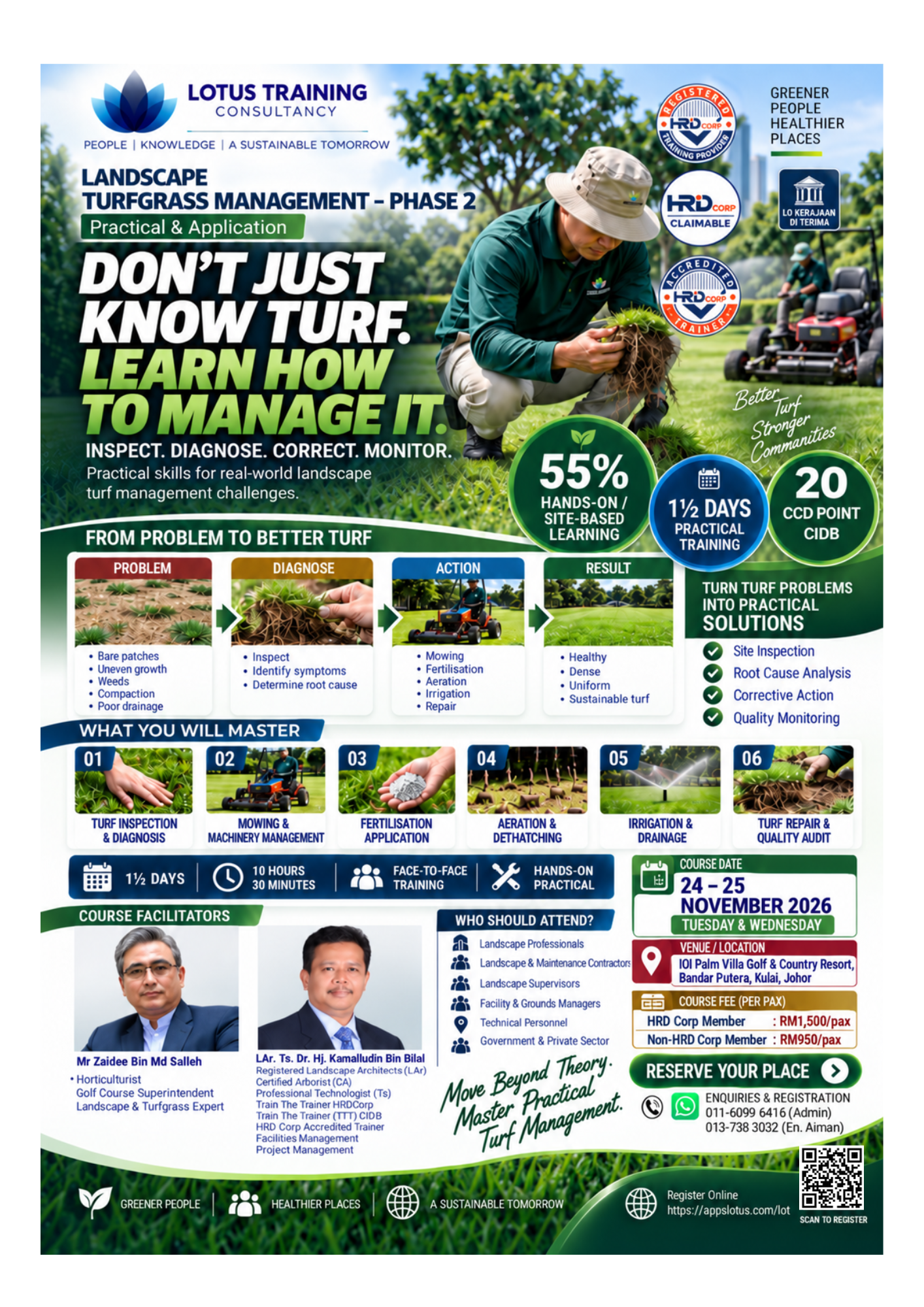
LANDSCAPE TURFGRASS MANAGEMENT - PHASE 2 (PRACTICAL & APPLICATION)
By the end of the course, participants will be able to:
1. Conduct systematic turfgrass site inspections and assess turf quality, density, colour and uniformity.
2. Identify turf symptoms and determine possible root causes of turf deterioration.
3. Assess basic soil, root, thatch, moisture, compaction and drainage conditions.
4. Apply appropriate mowing techniques and conduct basic mower inspection and safety checks.
5. Understand and apply basic turf fertilisation principles, including application rates and uniform application.
6. Understand practical methods of aeration and dethatching to manage soil compaction and thatch.
7. Assess irrigation and drainage performance and identify water-related turf problems.
8. Identify basic weeds, diseases and pests affecting turfgrass.
9. Apply appropriate techniques for turf repair, patching and re-turfing.
10. Conduct a Turf Quality Audit and develop a practical Corrective Action Plan for identified site problems.
Speaker


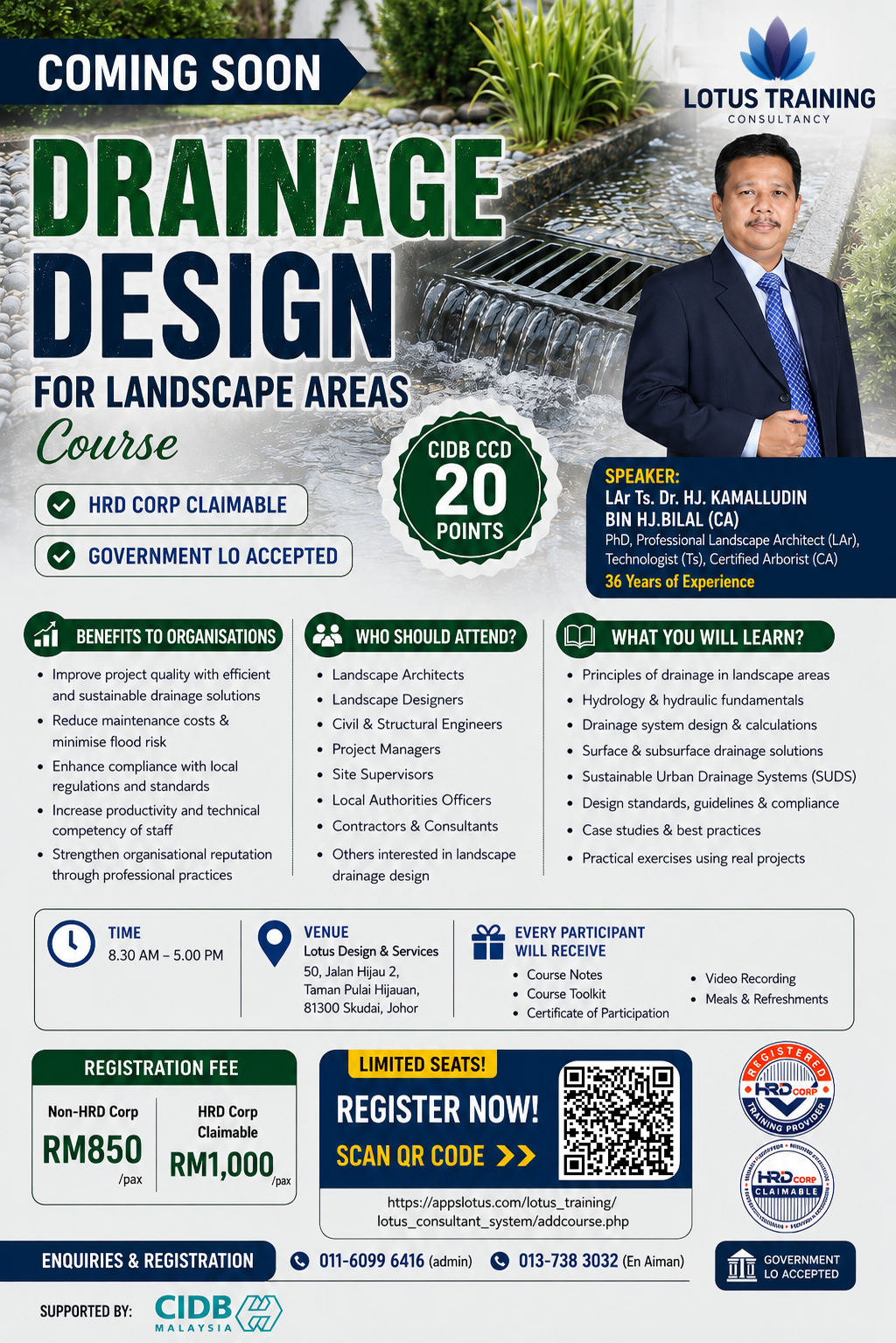
KURSUS DARINAGE DESIGN FOR LANDSCAPE AREAS
Upon completion of this course, participants will be able to:
1. Understand the fundamental principles of drainage design for landscape areas.
2. Identify drainage problems and recommend effective engineering solutions.
3. Design efficient surface and subsurface drainage systems for various landscape projects.
4. Apply hydrology and hydraulic concepts in practical landscape drainage planning.
5. Ensure compliance with Malaysian standards, environmental regulations, and sustainable drainage practices.
6. Improve project quality by minimizing waterlogging, erosion, flooding, and maintenance costs.
7. Develop practical skills through real-life case studies and design exercises.
Speaker